
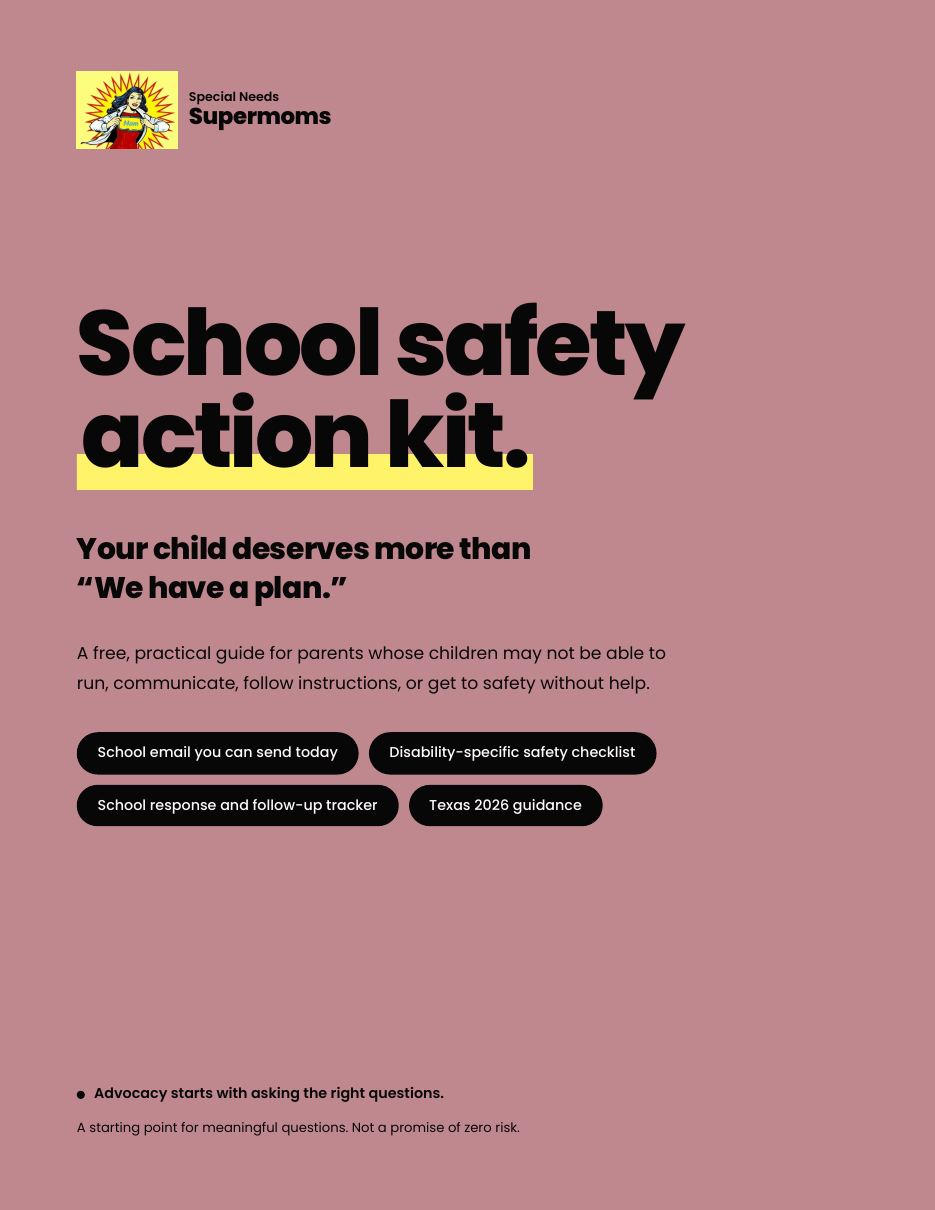
The free school safety kit
Your child deserves more than “We have a plan.”
When a special needs classroom was attacked in Bend, Oregon this week, I could not stop thinking about our kids. Many of them cannot run, cannot hide, cannot understand the danger, and cannot call for help.
I know change in government takes time, and our children are in classrooms today. So I put this kit together to help you start where we can: our own schools, districts and towns. You do not have to figure out what to say.
First 15 minutes
Put your concern into action.
You do not need a perfect speech or a law degree. Start with a specific request, then get a written response.
Send the email.
Customize the letter below and send it to your child’s principal.
Use the checklist.
Circle the questions that matter most to your child. Ask for a conversation about those needs, not confidential school security maps.
Request a team review.
If accommodations are missing or unclear, ask your child’s IEP or 504 team to review them and decide what should be documented.
Track the answers.
Write down who will assist, who is the backup, what will change, and when you will hear back.
Copy, personalize, send
The email you can send today.
Replace the brackets. If you are comfortable, include only the child-specific details the school needs.
Subject: Request to Review My Child’s Emergency Safety Accommodations
Dear [Principal/School Team],
I’m writing to request a review of the emergency safety accommodations in place for my child, [Child’s Name], who is in [Grade/Classroom].
Because of my child’s disabilities, they may not be able to [evacuate independently / understand emergency directions / communicate distress / manage medical needs] during a lockdown, evacuation, or other emergency. I appreciate the care your staff provides, and I want to understand how the school’s procedures address these individual needs.
Could you please help clarify the following?
- Who is responsible for assisting my child during different emergencies, and who is the backup if that person is unavailable?
- How are my child’s mobility, communication, behavioral/sensory, and medical needs addressed?
- Has the classroom’s location been reviewed for both accessibility and security, including alternative safe routes?
- How are staff and substitutes informed of my child’s needed supports, and how are procedures evaluated during drills?
I would appreciate a written summary of the accommodations and staff responsibilities relevant to my child. I understand that some campus security details cannot be shared. If any supports need to be added or updated, I would also like to discuss them with the IEP/ARD or Section 504 team, as applicable.
Please let me know who the appropriate contact is and a good time to discuss this. Thank you for helping ensure that students who cannot independently protect themselves are included in emergency preparedness.
Sincerely,
[Your Name]
[Phone/Preferred Contact]
What is in the kit
The questions we forget to ask.
The PDF has everything on one set of pages you can print, photograph, or keep on your phone. Ask for concrete answers about your child’s supports, without requesting security details a school cannot share.
Questions about staffing and backups, communication and sensory needs, medical and personal care, classroom location, drills, and how the school will reach you.
A page to write down who assists your child, who the backup is, what was confirmed, and what still needs an answer.
If you get “we take safety seriously,” here is what to say next, so the conversation keeps going.
Texas parents
A 2026 update for Texas schools.
Texas updated its school drill rule to address equal access to safety for students and staff with access and functional needs. It asks school systems to designate someone to make sure campuses review IEPs and 504 plans for emergency safety accommodations, and to document and share those accommodations while protecting student privacy.
The last page of the kit goes through it, along with a question you can ask your campus. Parents in other states should check local rules. You can read the rule itself on the TEA website (19 TAC §103.1209).
“Who is the designated person reviewing disability-related emergency accommodations at our campus, and how have my child’s needs been considered?”
One more thing
Let’s turn our anger into action.
Our children cannot always protect themselves. Their lives are not worth any less, and their safety should never be an afterthought.
We cannot control everything. But we can advocate for better preparation. Send the email, save this page, and share it with another special needs parent. Let’s make sure our children are part of the safety conversation.
With love, Nazia
This kit is an educational resource, not legal advice. It is a starting point for meaningful questions, not a promise of zero risk. Schools may limit disclosure of sensitive emergency response details, and the general pages are conversation tools, not a universally mandated standalone plan.